|
 |
 |
 |
 |
 |
AutoFEM Analysis Torsion of a Beam with the Square Cross-Section |  |
|
|
|
|
|
|
AutoFEM Analysis Torsion of a Beam with the Square Cross-Section | |
Torsion of a Beam with the Square Cross-Section
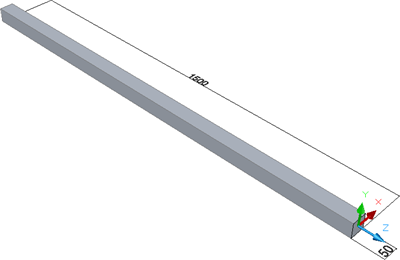
Let us consider a beam with the square cross-section. The length of the side of a square is a. Length of the beam is L (see figure).
|
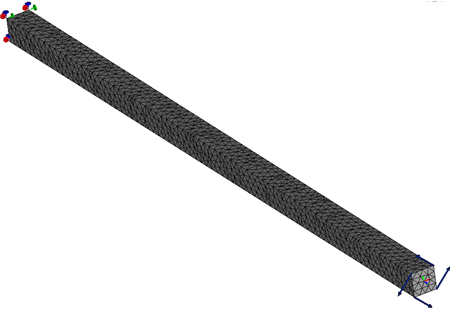
The beam is subjected to the externally applied torque Mt. The torque is applied at the right end of the beam, the left end of the beam is rigidly clamped.
|
The finite element model with applied loads and restraints |
Let us use the following initial data: length L of the beam is 1.5 m, the length of the side of a square a is 0.050 m, the magnitude of the applied torque Mt is 1000 N-m.
Material characteristics: E = 2.0E+011 Pa, ν = 0.29.
To find the angle of twist, let us use the following relation:
 ,
,
where G=E/2(1+ν) – shear modulus, Jp=βa4 – polar moment of inertia of the square cross-section, β= 0.1406.
Thus, ϕ= 2.2168E-002 rad.
The maximal displacement is calculated by the following formula:
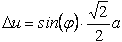
Thus, Δu = 7.8371E-004 m.
The maximal shear stress τ max is calculated by the following formula:

where α= 0.208
Thus, τ max = 3.8462E+007 Pa.
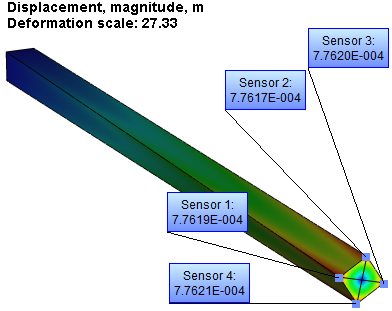
After carrying out calculation with the help of AutoFEM, the following results are obtained:
Table 1.Parameters of finite element mesh
Finite Element Type |
Number of nodes |
Number of Finite Elements |
quadratic tetrahedron |
24449 |
14862 |
Table 2. Result "Displacement"
Numerical Solution |
Analytical Solution |
Error δ = 100%* | Δu* - Δu | / | Δu | |
7.7619E-004 |
7.8371E-004 |
0.96 |
Table 3. Result "Shear Stress"
Numerical Solution |
Analytical Solution |
Error δ = 100%*| τmax* - τmax | / | τmax | |
4.0144E+007 |
3.8462E+007 |
4.37 |
|
|
Conclusions:
The relative error of the numerical solution compared to the analytical solution is 0.96% for displacements and 4.37% for stresses when using quadratic finite elements.
*The results of numerical tests depend on the finite element mesh and may differ slightly from those given in the table.
Read more about AutoFEM Static Analysis